
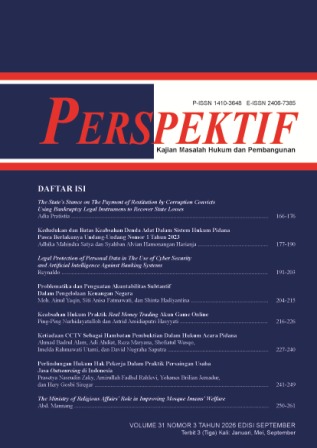
The Ministry of Religious Affairs’ Role in Improving Mosque Imams’ Welfare
DOI:
https://doi.org/10.30742/perspektif.v31i3.1040Keywords:
Ministry of Religious Affairs, mosque imams, welfareAbstract
This research is motivated by the structural gap between the strategic role of mosque imams in the religious life of society and the lack of formal state attention to their welfare. Although the Ministry of Religious Affairs institutionally holds the mandate to foster religious life, there is still no national policy that explicitly affirms the socio-economic rights of mosque imams The findings reveal that, despite a clear legal basis, the implementation of Ministry policies has not fully supported the economic well-being of mosque imams. Most imams still receive allowances below the regional minimum wage, with primary obstacles including budget constraints, weak inter-agency coordination, and the absence of standardized performance indicators. This study proposes an integrative policy model comprising four pillars: regulatory harmonization between Islamic and national law, sustainable financing through blended sources (state budget, local budget, and community-based funding), transparent governance supported by technology, and measurable key performance indicators (KPIs). This model is recommended as a foundation for national policy formulation to ensure a just, sustainable, and socially responsive system for mosque imam welfare in Indonesia.
References
Buljan, Ivan, Ruzica Tokalic, Vicko Tomic, Marin Vidak, and Ana Marusic. “Student Moral Foundations in the Context of Research Misbehavior: An Experimental Study.” J Empir Res Hum Res Ethics 18, no. 3 (2023): 154–60. https://doi.org/https://doi.org/10.1177/15562646231168919.
Ebny, Ruth A., Patricia Lynn Hartley, Patricia Jeanne Hodges, Rebecca Hoffpauir, Shirlene Newbanks, and Jane H. Kelley. “Moral Integrity and Moral Courage: Can You Teach It?” Journal of Nursing Education 52, no. 4 (2013): 229–33. https://doi.org/10.3928/01484834-20130311-01.
Fahrudin, and Pandu Hyangsewu. “Manajemen Pengelolaan Masjid Menuju Masjid Yang Bersih, Suci, dan Sehat Berbasis Teknologi Informasi.” Jurnal Abmas 22, no. 2 (2022): 63–70.
Gazarian, Priscilla K, Constance R C Morrison, Lisa Soleymani Lehmann, Orly Tamir, David W Bates, and Ronen Rozenblum. “Patients’ and Care Partners’ Perspectives on Dignity and Respect During Acute Care Hospitalization.” J Patient Saf 17, no. 5 (2021): 392–97.
Hurairah, Abu, and Mahsuri. “Kesejahteraan Sosial Petugas Masjid Kota Bengkalis Dan Sekitarnya: Ragam Tugas, Upah dan UMK.” Jurnal Matlamat Minda 1, no. 2 (2021): 1–10.
Jufri, Muwaffiq, and Mukhlish. “Akibat Hukum Pemisahan Hak Beragama Dengan Hak Berkepercayaan Dalam Undang-Undang Dasar Negara Republik Indonesia Tahun 1945.” Jurnal Konstitusi 16, no. 2 (2019): 274–95. https://doi.org/10.31078/jk1624.
Karaman, Jamilah, Muh. Syarif Hidayatullah, Ajudya Andika Putra Pranata, Fergiawan Restianto, Uga Alde Riwandi, Marzello Alfathurtama, Almer Elvis Adam Haz Pradikto, and Muhammad Alwi Zamzam Alfarisi. “Pembangunan Menara Masjid Al Musnawiyatul Islam Dukuh Sidowayah Sebagai Pengeras Suara Dan Upaya Pembangunan Fasilitas Keagamaan.” Jurnal Masyarakat Merdeka 6, no. 2 (2023): 132–42. https://doi.org/10.51213/jmm.v6i2.144.
Manalu, Paris, Sugianto, and Andi Lala. “Comparison of the Value of Welfare Principles in National Law and Islamic Law.” International Journal of Social Service and Research 3, no. 11 (2023): 2811–16.
Mustain. “Dinamika Fungsi Masjid di Indonesia: Dari Lokus Pengajaran Islam Ke Pemberdayaan Sosial Ekonomi Umat.” EL-HIKMAH: Jurnal Kajian dan Penelitian Pendidikan Islam 17, no. 2 (2023): 109–21. https://doi.org/10.20414/elhikmah.v17i2.8998.
Nawawi, Ahmad. “Arah Kebijakan Perlindungan Sosial ke Depan Untuk Meningkatkan Kesejahteraan Masyarakat.” Jurnal Syntax Admiration 2, no. 10 (2021): 1824–38.
Patriawan, Gema. “Mekanisme Pengupahan (Ujrah) Pada Pengurus Masjid di Kabupaten Kubu Raya: Suatu Tinjauan Syariah.” JMI: Jurnal Muamalat Indonesia 4, no. 1 (2024): 418–30.
Rachman, Rio Febriannur. “The Policy to Optimization of Social Media for Traffic Management in Islamic Perspectives.” Journal of Islamic Civilization 3, no. 1 (2021): 13–23.
Sarbini, Muhammad, Muslim, Ade Kohar, Endra Bahtiar, and Deden Supriatna. “Pendidikan dan Pemberdayaan Masyarakat Tentang Pungsi Masjid Sebagai Sentral Kegiatan Umat Melalui Pengabdian Kepada Masyarakat.” Khidmatul Ummah: Jurnal Pengabdian Kepada Masyarakat 1, no. 1 (2020): 26–38. https://doi.org/10.30868/khidmatul.v1i01.982.
Sayem, Md. Abu, Naerul Edwin Kiky Aprianto, and Adam Voak. “Perspective on the Islamic Welfare State: The Goals of Economic Development Justice.” El-Jizya: Jurnal Ekonomi Islam 11, no. 1 (2023): 103–20.
Shaharuddin, Syarul Azman, Norsaleha Mohd Salleh, Abur Hamdi Usman, Alawiyah Tengah, Aemy Elyani Mat Zain, Nur Uswah Ahmad Fauzi, and Raden Saidatul Akmar Hasnan. “Peranan Masjid Dalam Menyantuni Asnaf Al-Riqab.” Jurnal Pengajian Islam 17, no. 2 (2024): 113–25. https://doi.org/10.53840/jpi.v17i2.348.
Shomad, Abd. “Dinamisasi Penormaan Hukum Islam.” PERSPEKTIF: Kajian Masalah Hukum dan Pembangunan 15, no. 2 (2010): 99–122. https://doi.org/10.30742/perspektif.v15i2.47.
Siskawati, Eka, Ferdawati, and Firman Surya. “Bagaimana Masjid dan Masyarakat Saling Memakmurkan? Pemaknaan Akuntabilitas Masjid.” Jurnal Akuntansi Multiparadigma 7, no. 1 (2016): 70–80. https://doi.org/10.18202/jamal.2016.04.7006.
Thoha, Ahmad Faiz Khudlari, Shobikhul Qisom, and Fatih Al-Qarni. “Optimalisasi Masjid Perumahan Sebagai Ruang Publik dan Poros Kegiatan Masyarakat.” Masjiduna: Junal Ilmiah Stidki Ar-Rahmah 4, no. 1 (2021): 29–36.
Tuanany, Ismail, Mahdi Malawat, and Syarifudin. “Penguatan Dakwah Kebangsaan Imam Masjid Rijali di Ambon.” Reswara: Jurnal Pengabdiian Kepada Masyarakat 3, no. 1 (2022): 35–47. https://doi.org/10.46576/rjpkm.v3i1.1237.
Warden, Rosalind, Jonathan Scourfield, and Peter Huxley. “Islamic Social Work in the UK: The Service User Experience.” British Journal of Social Work 47, no. 3 (2017): 737–54. http://www.jstor.org/stable/26364170.
Downloads
Published
Issue
Section
License

This work is licensed under a Creative Commons Attribution-ShareAlike 4.0 International License.
Authors who publish with this journal agree to the following terms:
- Authors retain copyright and grant the journal right of first publication with the work simultaneously licensed under a Attribution-ShareAlike 4.0 International (CC BY-SA 4.0) License that allows others to share the work with an acknowledgement of the work's authorship and initial publication in this journal.
- Authors are able to enter into separate, additional contractual arrangements for the non-exclusive distribution of the journal's published version of the work (e.g., post it to an institutional repository or publish it in a book), with an acknowledgement of its initial publication in this journal.
- Authors are permitted and encouraged to post their work online (e.g., in institutional repositories or on their website) prior to and during the submission process, as it can lead to productive exchanges, as well as earlier and greater citation of published work (See The Effect of Open Access).
The Authors submitting a manuscript do so on the understanding that if accepted for publication, copyright of the article shall be assigned to jurnal PERSPEKTIF and Research Institutions and Community Service, Wijaya Kusuma Surabaya University as publisher of the journal.