
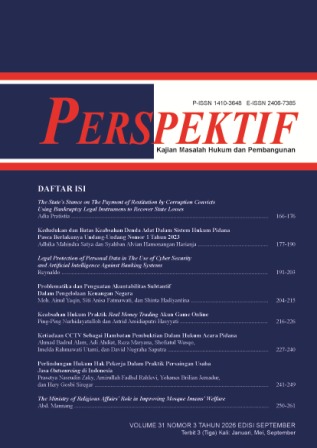
The State’s Stance on The Payment of Restitution by Corruption Convicts Using Bankruptcy Legal Instrumens to Recover State Losses
DOI:
https://doi.org/10.30742/perspektif.v31i3.1060Keywords:
corruption, replacement money, bankruptcy, state attorney, public interestAbstract
Combating corruption in Indonesia faces significant challenges, particularly regarding the effectiveness of recovering state financial losses through the imposition of “restitution money” as an additional criminal penalty. This study aims to analyze the legal status of unpaid restitution money owed by a convicted corruptor specifically whether it constitutes a debt subject to bankruptcy proceedings and to examine the legitimacy and legal standing of the State Attorney in this context. The findings indicate that an obligation to pay restitution money once the court ruling has become final and binding (inkracht) is essentially a financial obligation with economic value that can be categorized as a debt. If a convicted individual has two or more creditors (including the state) and fails to pay a due debt, the criteria for bankruptcy under Article 2, paragraph (1) of Law No. 37/2004 may be met. Applying bankruptcy legal instruments (mutatis mutandis) could serve as an effective legal breakthrough for the state to recover financial losses caused by bankrupt convicted corruptors. To optimize the role of the Prosecutor’s Office as a bankruptcy petitioner acting in the public interest, it is required to enhance the capacity of prosecutorial personnel regarding bankruptcy law and to conduct broader public outreach.
References
Regulations:
Undang-Undang Nomor 31 Tahun 1999 tentang Pemberantasan Tindak Pidana Korupsi. (Lembaran Negara Tahun 1999 Nomor 140, Tambahan Lembaran Negara Nomor 3874).
Undang-Undang Nomor 20 Tahun 2001 tentang Perubahan atas Undang-Undang Nomor 31 Tahun 1999 tentang Pemberantasan Tindak Pidana Korupsi. (Lembaran Negara Tahun 2001 Nomor 134, Tambahan Lembaran Negara Nomor 4150).
Undang-Undang Nomor 37 Tahun 2004 tentang Kepailitan dan Penundaan Kewajiban Pembayaran Utang. (Lembaran Negara Tahun 2004 Nomor 131, Tambahan Lembaran Negara Nomor 4443).
Books:
Aditya, Kukuh Leksono Suminaring. “Kepailitan Sebagai Alternatif Instrumen Penagihan Penerimaan Negara Bukan Pajak.” Universitas Airlangga, 2024.
Erisna, Harahap. Pemberantasan Korupsi Jalan Tiada Ujung. Bandung: Grafiti, 2006.
Honderich, Ted. Punishment, The Supposed Justifications. USA: Cambridge, 1989.
Kaelan. Filsafat Pancasila Pandangan Hidup Bangsa Indonesia. Yogyakarta: Paradigma, 2009.
Kholis, Efi Laila. Pembayaran Uang Pengganti Dalam Perkara Korupsi. Jakarta: Solusi Publishing, 2010.
Kusumohamidjojo, Budiono. Filsafat Hukum: Problematik Ketertiban Yang Adil. Bandung: Yrama Widya, 2022.
Mamudji, Sri. Metode Penelitian dan Penulisan Hukum. Depok: Badan Penerbit Fakultas Hukum Uiversitas Indonesia, 2005.
Sjahdeni, Sutan Remy. Sejarah, Asas, dan Teori Hukum Kepailitan: Memahami Undang-Undang No. 37 Tahun 2004 tentang Kepailitan dan Penundaan Kewajiban Pembayaran Utang. Cetakan ke. Jakarta: Pranada Media Group, 2018.
Subhan, M. Hadi. Prinsip, Norma, dan Praktik di Peradilan. Cetakan ke. Jakarta: Kencana, 2008.
Sutedi, Andrian. Aspek Hukum Otoritas Jasa Keuangan. Jakarta: Raih Asa Sukses, 2014.
Wijayanto, Ridwan Zachrie. Korupsi Mengorupsi Indonesia: Sebab, Akibat, dan Prospek Pemberantasan. Jakarta: Gramedia, 2010.
Zurnetti, Teguh Sulistia dan Aria. Hukum Pidana, Horizon Baru Pasca Reformasi. Jakarta: Raja Grafindo Persada, 2011.
Journals:
Afifah dan Sri Warjiyati, Fatmah. “Tujuan, Fungsi dan Kedudukan Hukum.” Jurnal Ilmu Hukum Wijaya Putra 2, no. 2 (2024): 142–52.
Febrianty, Yenny. “Implementasi Kewenangan Kejaksaan Sebagai Pemohon Dalam Mengajukan Kepailitan Demi Kepentingan Umum Berbasis Nilai Keadilan Sosial.” Jurnal Hukum Sehasen 2, no. 1 (2019): 1–25.
Kosasih, Yudi. “Tumpang Tindih Sita Umum Kepailitan dan Sita Pidana Terhadap Objek Boedel Pailit Yang Juga Menjadi Barang Bukti Dalam Sebuah Peristiwa Tindak Pidana Dalam Perspektif Asas Lex Specialis Derogat Legi Generali.” Universitas Pakuan Bogor, 2021.
Mahardika, Muhammad Dzakir Gusti. “Tinjauan Penerapan Sita Jaminan (Conservatoir Beslag) Dalam Tindak Pidana Korupsi.” Jurist-Diction 3, no. 2 (2020): 499–518. https://doi.org/10.20473/jd.v3i2.18201.
Munzil, Imas Rosidawati Wr dan Sukendar, Fontian. “Kesebandingan Pidana Uang Pengganti dan Pengganti Pidana Uang Pengganti Dalam Rangka Melindungi Hak Ekonomis Negara dan Kepastian Hukum.” Jurnal Hukum IUS QUIA IUSTUM 22, no. 1 (2015): 25–53.
Wijayanti dan Siti Malikhatun Bariyah, Riska. “Implementasi Pengaturan Jaksa Pengacara Negara Dalam Penanganan Perkara Kepailitan di Kejaksaan Negeri Banjarmasin.” Law Reform 16, no. 2 (2020): 192.
Yuhdi, M. “Tugas dan Wewenang Kejaksaan Dalam Pelaksanaan Pemilihan Umum.” Jurnal Ilmiah Pendidikan Pancasila dan Kewarganegaraan 27, no. 2 (2014): 93–102.
Downloads
Published
Issue
Section
License

This work is licensed under a Creative Commons Attribution-ShareAlike 4.0 International License.
Authors who publish with this journal agree to the following terms:
- Authors retain copyright and grant the journal right of first publication with the work simultaneously licensed under a Attribution-ShareAlike 4.0 International (CC BY-SA 4.0) License that allows others to share the work with an acknowledgement of the work's authorship and initial publication in this journal.
- Authors are able to enter into separate, additional contractual arrangements for the non-exclusive distribution of the journal's published version of the work (e.g., post it to an institutional repository or publish it in a book), with an acknowledgement of its initial publication in this journal.
- Authors are permitted and encouraged to post their work online (e.g., in institutional repositories or on their website) prior to and during the submission process, as it can lead to productive exchanges, as well as earlier and greater citation of published work (See The Effect of Open Access).
The Authors submitting a manuscript do so on the understanding that if accepted for publication, copyright of the article shall be assigned to jurnal PERSPEKTIF and Research Institutions and Community Service, Wijaya Kusuma Surabaya University as publisher of the journal.