
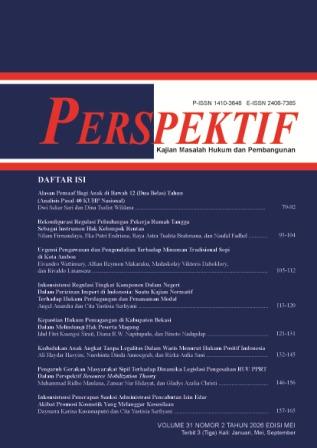
Inkonsistensi Regulasi Tingkat Komponen Dalam Negeri Dalam Perizinan Import di Indonesia: Suatu Kasus Kajian Normatif Terhadap Hukum Perdagangan dan Penanaman Modal
DOI:
https://doi.org/10.30742/perspektif.v31i2.1006Keywords:
hukum perdagangan internasional, kepastian hukum, penanaman modal, TKDN, international trade law, legal certainty, investment, local content requirementAbstract
Penelitian ini bertujuan untuk menganalisis kontradiksi regulasi dalam penerapan kebijakan Tingkat Komponen Dalam Negeri (TKDN) sebagai prasyarat perizinan impor di Indonesia. Fokus utama penelitian ini adalah pertentangan antara kebijakan proteksi industri nasional dengan komitmen Indonesia terhadap hukum perdagangan internasional dan asas-asas dasar penanaman modal. Secara eksternal, kebijakan TKDN berpotensi melanggar prinsip National Treatment dalam Pasal III General Agreement on Tariffs and Trade (GATT) 1994 serta larangan performance requirement dalam Agreement on Trade- Related Investment Measures (TRIMs). Sementara secara internal, penerapan TKDN sebagai syarat perizinan impor menimbulkan persoalan terhadap asas kepastian hukum dan transparansi sebagaimana diatur dalam Undang-Undang Nomor 25 Tahun 2007 tentang Penanaman Modal. Metode penelitian yang digunakan adalah yuridis normatif, dengan dua pendekatan utama yaitu pendekatan perundang-undangan dan pendekatan konseptual. Hasil penelitian menunjukkan adanya kontradiksi normatif yang signifikan antara kebijakan TKDN sebagai instrumen proteksi industri dengan kewajiban hukum perdagangan internasional serta prinsip penanaman modal yang menjamin kepastian hukum. Diperlukan harmonisasi regulasi agar kebijakan TKDN dapat sejalan dengan prinsip keterbukaan perdagangan dan iklim investasi yang berkeadilan.
This study aims to analyze regulatory contradictions in the implementation of the Domestic Component Level (TKDN) policy as a prerequisite for import licensing in Indonesia. The primary focus of this research is the conflict between national industrial protection policies and Indonesia’s commitment to international trade law and basic investment principles. Externally, the TKDN policy has the potential to violate the principle of National Treatment in Article III of the General Agreement on Tariffs and Trade (GATT) 1994 and the prohibition on performance requirements in the Agreement on Trade-Related Investment Measures (TRIMs). Internally, the application of TKDN as a requirement for import licensing raises issues regarding the principles of legal certainty and transparency as stipulated in Law Number 25 of 2007 concerning Investment. The research method used is a normative juridical approach, with two main approaches: a statutory approach and a conceptual approach. The results indicate a significant normative contradiction between the TKDN policy as an instrument of industrial protection, and the obligations of international trade law and the investment principle that guarantees legal certainty. Regulatory harmonization is required to ensure that the TKDN policy aligns with the principles of trade openness and a just investment climate.
References
Peraturan Perundang-undangan:
General Agreement on Tariffs and Trade 1994.
Agreement on Trade-Related Investment Measures.
Undang-Undang Nomor 25 Tahun 2007 tentang Penanaman Modal. (Lembaran Negara Republik Indonesia Tahun 2007 Nomor 67, Tambahan Lembaran Negara Republik Indonesia Nomor 4724).
Undang-Undang Nomor 6 Tahun 2003 tentang Cipta Kerja. (Lembaran Negara Republik Indonesia Tahun 2003 Nomor 41, Tambahan Lembaran Negara Republik Indonesia Nomor 6856).
Peraturan Pemerintah Nomor 28 Tahun 2021 tentang Penyelenggaraan Bidang Perindustrian.
Buku:
Hasanah, Lak Lak Nazhat El, Dassucik, and Ida Farida. Strategi Menuju Negara Berkembang. Sukoharjo: Tahta Media Group, 2025.
Wibowo, Agus. Hukum Dagang Internasional. Semarang: Penerbit Yayasan Prima Agus Teknik, 2025.
Zes, Etty Zuliawati, Pepen Komarudin, and Nanci Margaret Teresia Napitupulu. Ekonomi Internasional. Padang: Takaza Innovatix Labs, 2025.
Jurnal:
Ardiana, Oktavia Dwi, Dinda Azzahra, Hana Humaira Sachmaso, and Razky Fawwaz. “Penerapan TKDN Dalam Pengadaan Pemerintah dan Implikasinya Terhadap Persaingan Usaha.” Media Hukum Indonesia (MHI) 3, no. 4 (2025): 578–89.
Febrina, Mitha, Subhan Fajrian, Syakila Azzahra, and Rayhan Akbar Gifarly. “Persepsi User Iphone Terhadap Kebijakan Pemerintah Atas Pembatalan Rilis Iphone 16 di Indonesia.” Socius: Jurnal Penelitian Ilmu-Ilmu Sosial 2, no. January (2025): 144–48.
Giovannus, Davin. “Pengaturan Tingkat Kandungan Dalam Negeri (TKDN) atau Local Content Requirements di Indonesia.” Jurnal Paradigma Hukum Pembangunan 5, no. 01 (2020): 81–107. https://doi.org/10.25170/paradigma.v5i01.2182.
Hardenta, Alif Duta, Shafira Dinda Ariefti, and Wiweko Rahadian Abyapta. “Pengaruh Implementasi Kebijakan Proteksionisme Melalui Tingkat Komponen Dalam Negeri Terhadap Tender/Seleksi Internasional.” Jurnal Hukum Ius Quia Iustum 30, no. 1 (2023): 114–37. https://doi.org/10.20885/iustum.vol30.iss1.art6.
Indrayani, Irma, and Anggi Ramadhanty. “Strategi Apple Inc. Dalam Penguasaan Pasar Produk Teknologi di Indonesia Tahun 2015-2019.” Jurnal Ilmu dan Budaya 41, no. 67 (2020): 1–18.
Ismail, Fadhil Fadhluraman Putra, Rayner A Panjaitan, Vriyan Holten Marpaung, Benny Kenjiroh M, and Farahdinny Siswajanthy, S.H., M.H. “Pengaruh Globalisasi Terhadap Pertumbuhan Ekonomi di Negara Berkembang: Analisis Dampak Investasi Asing Langsung (FDI), Ekspor, dan Perdagangan Bebas Terhadap Pertumbuhan Ekonomi di Negara-Negara Berkembang.” Indonesian Journal of Islamic Jurisprudence, Economic and Legal Theory 3, no. 1 (2025): 30–41.
Komang Rama Agastya. “Implikasi Undang-Undang Cipta Kerja Terhadap Investasi Asing: Permasalahan Perizinan, Pajak dan Sosial.” Semarang Law Reviewe (SLR) 6, no. 1 (2023): 36–44. https://doi.org/10.26623/slr.v6i1.11872.
Downloads
Published
Issue
Section
License

This work is licensed under a Creative Commons Attribution-ShareAlike 4.0 International License.
Authors who publish with this journal agree to the following terms:
- Authors retain copyright and grant the journal right of first publication with the work simultaneously licensed under a Attribution-ShareAlike 4.0 International (CC BY-SA 4.0) License that allows others to share the work with an acknowledgement of the work's authorship and initial publication in this journal.
- Authors are able to enter into separate, additional contractual arrangements for the non-exclusive distribution of the journal's published version of the work (e.g., post it to an institutional repository or publish it in a book), with an acknowledgement of its initial publication in this journal.
- Authors are permitted and encouraged to post their work online (e.g., in institutional repositories or on their website) prior to and during the submission process, as it can lead to productive exchanges, as well as earlier and greater citation of published work (See The Effect of Open Access).
The Authors submitting a manuscript do so on the understanding that if accepted for publication, copyright of the article shall be assigned to jurnal PERSPEKTIF and Research Institutions and Community Service, Wijaya Kusuma Surabaya University as publisher of the journal.