
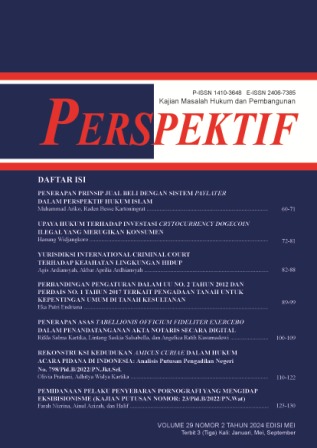
YURISDIKSI INTERNATIONAL CRIMINAL COURT TERHADAP KEJAHATAN LINGKUNGAN HIDUP
DOI:
https://doi.org/10.30742/perspektif.v29i2.941Kata Kunci:
lingkungan hidup; ekosida, hukum internasional; international criminal courtAbstrak
Penelitian ini mengeksplorasi potensi yurisdiksi International Criminal Court (ICC) dalam menangani kejahatan lingkungan hidup, dengan fokus khusus pada konsep ekosida sebagai kejahatan internasional. Meskipun ICC belum secara resmi mengakui ekosida sebagai jenis kejahatan dalam Statuta Roma, diskusi mengenai pengakuan ini telah meningkat seiring dengan krisis lingkungan global yang semakin parah. Melalui pendekatan normatif yuridis, penelitian ini menganalisis perkembangan hukum internasional yang berkaitan dengan kejahatan lingkungan dan mengevaluasi kemungkinan perluasan yurisdiksi ICC untuk memasukkan kejahatan lingkungan sebagai bagian dari mandatnya. Hasil penelitian menunjukkan bahwa pengakuan kejahatan lingkungan di bawah yurisdiksi ICC dapat memperkuat perlindungan lingkungan global dan mengurangi impunitas pelaku yang terlibat dalam kerusakan lingkungan. Namun, tantangan hukum dan praktis, termasuk definisi dan elemen kejahatan ekosida, perlu diatasi untuk memungkinkan implementasi yang efektif. Penelitian ini memberikan kontribusi penting dalam diskursus hukum internasional mengenai perlindungan lingkungan dan penegakan hukum terhadap kejahatan lingkungan.
Kata Kunci: lingkungan hidup; ekosida, hukum internasional; international criminal court
Referensi
Perjanjian Internasional:
Statuta Roma
International Covenant on Civil and Political Rights (ICCPR)
Buku
M. Ridha Saleh. (2020). ECOCIDE: Melawan Pelanggaran HAM Berat di Indonesia. Jakarta: Rayyana Komunikasindo.
Victor Tsilonis. (2019). The Jurisdiction of The International Criminal Court. Springer: Cham.
Otto Triffterer dan Kai Ambos (Ed). (2016). The Rome Statute of the International Criminal Court: A Commentary 3rd Edition. Beck/Hart: Munich.
Artikel Jurnal
Devita Kartika Putri. (2019). “Interpreting ‘Most Serious Crimes’ under Article 6(2) of ICCPR”. Mimbar Hukum. 31(3), 419-437. https://doi.org/10.22146/jmh.48979
Geng Zhimin. (2023). “A Study on the Jurisdiction of the International Criminal Court”. Volume 10, Issue 9. 241-246. http://dx.doi.org/10.18415/ijmmu.v10i9.5155
Jessica Schaffer. (2020). “Prosecution of Wartime Environmental Damage by Non-State Parties at the International Criminal Court.” Bond Law Review. 32 (1), 151–64. https://doi.org/10.53300/001c.17931.
Liana Georgieva Minkova. (2023). “The Fifth International Crime: Reflections on the Definition of Ecocide”, Journal of Genocide Research, 25:1, 62-83, DOI: 10.1080/14623528.2021.1964688
Luigi Prosperi, Jacopo Terrosi. (2017). “Embracing the ‘Human Factor’: Is There New Impetus at the ICC for Conceiving and Prioritizing Intentional Environmental Harms as Crimes Against Humanity?”. Journal of International Criminal Justice. 15(3), 509-525. https://doi.org/10.1093/jicj/mqx032
Mehdi J. Hakimi. (2023). “The Genocide of Hazaras”. Virginia Journal of International Law Online. 63(19), 21-32. http://dx.doi.org/10.2139/ssrn.4262465
Ricardo Pereira. (2020). “After the ICC Office of the Prosecutor’s 2016 Policy Paper on Case Selection and Prioritisation: Towards an International Crime of Ecocide?”. Crim Law Forum 31, 179–224. https://doi.org/10.1007/s10609-020-09393-y
Rigmor Argren. (2023). “The Obligation to Prevent Environmental Harm in Relation to Armed Conflict”. International Review of the Red Cross, 105 (924), 1208–1226, Protecting the Environment in Armed Conflict. doi:10.1017/S1816383123000231
Shilpa S. Shetty and others. (2023). “Environmental Pollutants and Their Effects on Human Health”. Heliyon. 9(9), 1-13. doi: https://doi.org/10.1016/j.heliyon.2023.e19496
Artikel Internet
France24.com. “ICC Prosecutor Wants Court to Try “Environmental Crimes”. https://www.france24.com/en/live-news/20240207-icc-prosecutor-wants-court-to-try-environmental-crimes, diakses pada 24 Mei 2024.
Office of the Prosecutor. “The Office of the Prosecutor Launches Public Consultation on a New Policy Initiative to Advance Accountability for Environmental Crimes under the Rome Statute”. https://www.icc-cpi.int/news/office-prosecutor-launches-public-consultation-new-policy-initiative-advance-accountability-0, diakses pada 24 Mei 2024.
World Health Organization. “Preventing Disease through Healthy Environments: A Global Assessment of the Burden of Disease from Environmental Risks.” https://www.who.int/publications/i/item/9789241565, diakses pada 24 Mei 2024.
Unduhan
Diterbitkan
Terbitan
Bagian
Lisensi

Artikel ini berlisensiCreative Commons Attribution-ShareAlike 4.0 International License.
Authors who publish with this journal agree to the following terms:
- Authors retain copyright and grant the journal right of first publication with the work simultaneously licensed under a Attribution-ShareAlike 4.0 International (CC BY-SA 4.0) License that allows others to share the work with an acknowledgement of the work's authorship and initial publication in this journal.
- Authors are able to enter into separate, additional contractual arrangements for the non-exclusive distribution of the journal's published version of the work (e.g., post it to an institutional repository or publish it in a book), with an acknowledgement of its initial publication in this journal.
- Authors are permitted and encouraged to post their work online (e.g., in institutional repositories or on their website) prior to and during the submission process, as it can lead to productive exchanges, as well as earlier and greater citation of published work (See The Effect of Open Access).
The Authors submitting a manuscript do so on the understanding that if accepted for publication, copyright of the article shall be assigned to jurnal PERSPEKTIF and Research Institutions and Community Service, Wijaya Kusuma Surabaya University as publisher of the journal.